

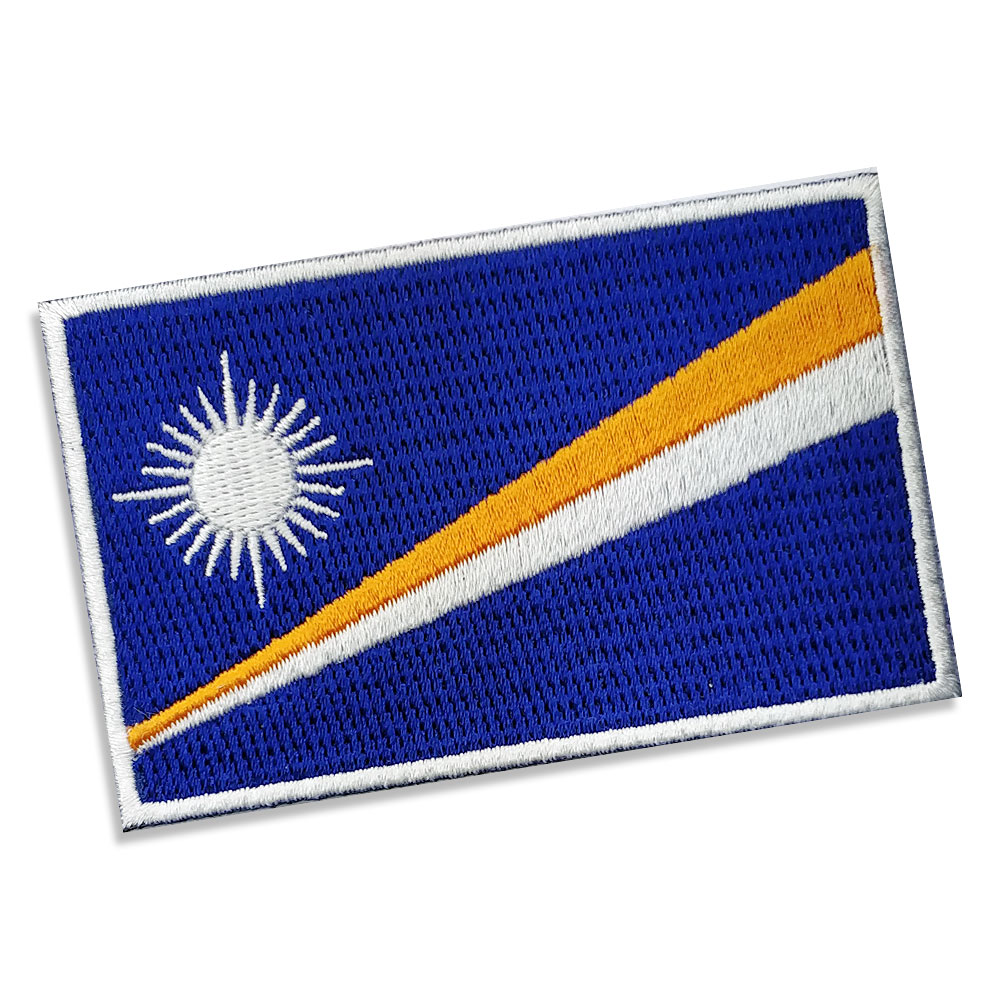
Flag of Marshall Islands Size: The National Flag of the country includes a dark blue foundation with two stripes. The orange is at the top and white at the bottom, which emanates from the lower end of the banner’s crane side corner to the upper finish of the banner’s fly-side corner. A sparkling white star with four huge beams and 20 little beams shows up on the left side over the stripes. The National Flag was authoritatively embraced on 1 May 1979. The banner has been planned by Emilian Kabua. The banner has a width-to-length extent of 10:19. Meaning: The inclining groups together address the equator and the upper and lower triangles represent the Northern and Southern Hemisphere, separately. The star in the upper triangle in this manner addresses the archipelago’s area in the Northern Hemisphere. The dark blue-hued foundation of the banner addresses the Pacific Ocean where the nation is found. The orange stripe connotes the Ralik Chain means sunset and represents fortitude/courage. The white stripe connotes the Ratak Chain means sunrise and represents harmony. The sparkling white star represents the cross of Christianity, with every one of the 24 little beams assigning one of the discretionary regions in the nation, and the four bigger beams featuring the essential social places of the country – Majuro, Jaluit, Wotje, and Ebeye. History:John Marshall was an explorer from Britain. He visited the Marshall Islands in 1788. Years and years following the revelation of this country by the Europeans, the different European powers began to build up their control there. Spain guaranteed the islands in 1592. A portion of the islands was sold by Spain to Germany and accordingly, these islands turned into a piece of German New Guinea. The banner of the German Empire was the principal banner flown there in 1878. This banner was utilized until 1894. Control of the country went to Japan during WWI, then the US claimed the territory. A UN flag was flown there. In 1944, the US Flag was first adopted. The banner was being used for a long time. On 1 May 1979, when the nation accomplished the status of self-administration, the public banner of the country was formally embraced. Interesting Facts: Each place on the star represents a region on the islands. The largest shafts address the legitimate focal points of Majuro, Jaluit, Wotje, and Ebeye. The long shafts moreover structure a cross symbol and are planned to reflect the Christian religion of the country. 70 181
Related products
-
New Zealand
€2.99 -
Solomon Islands
€2.99 -
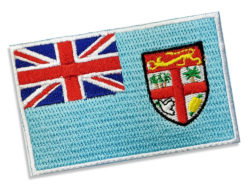
Fiji
€2.99
Reviews
There are no reviews yet.